
A missed hazard or a missing form shouldn’t be what an audit turns up.
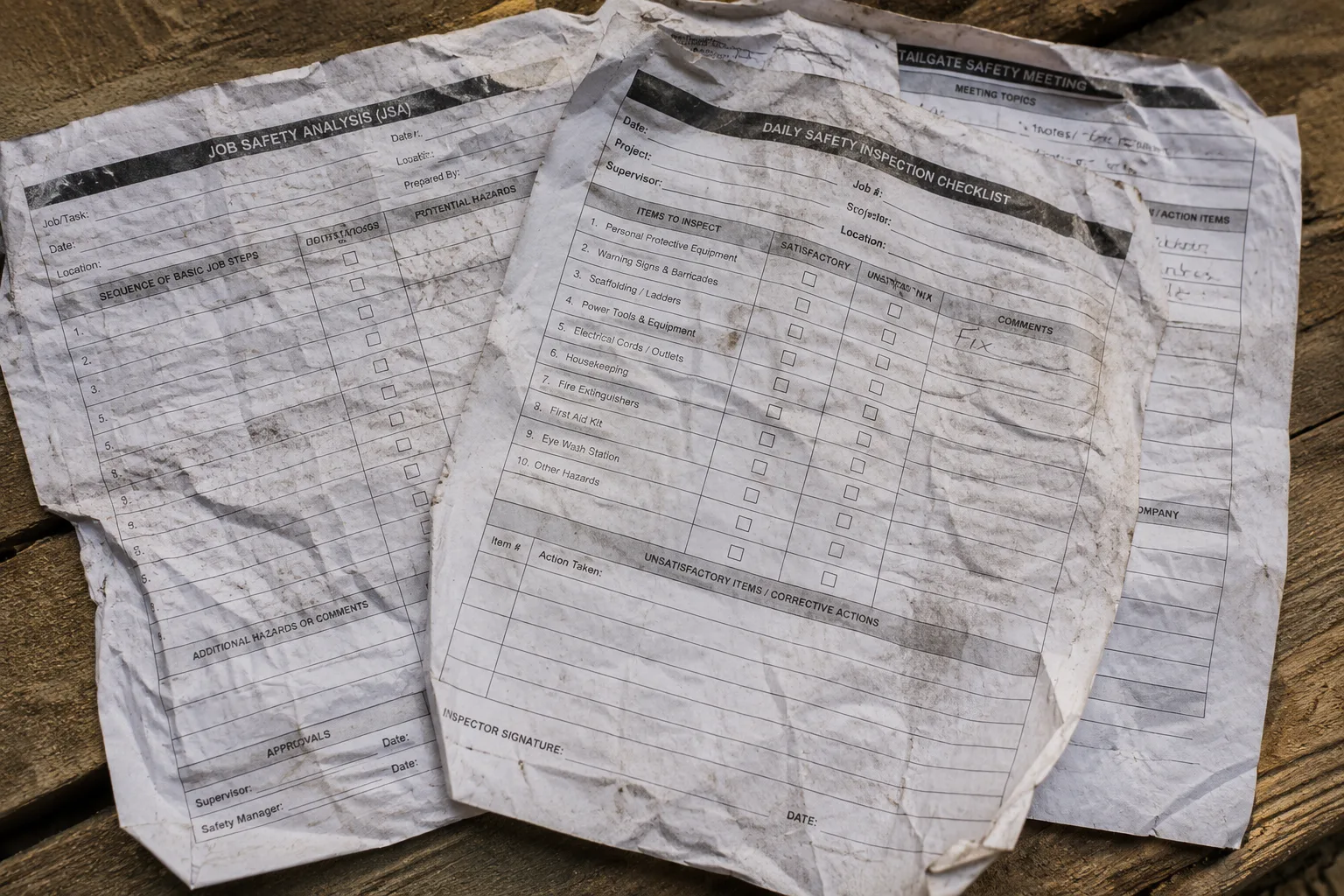
Toolbox-talk sign-in sheets, JHAs, near-miss reports, and inspection checklists still pile up on clipboards at plants, jobsites, and field offices across manufacturing, utilities, construction, agriculture, and government. Paper delays get findings to the safety team, corrective actions fall through the cracks, repeat hazards go unnoticed, and worker accountability is hard to prove. Manual reporting slows investigations, and when a regulator asks for records, teams scramble to compile them under real compliance pressure.
Every inspection captured, every corrective action closed.
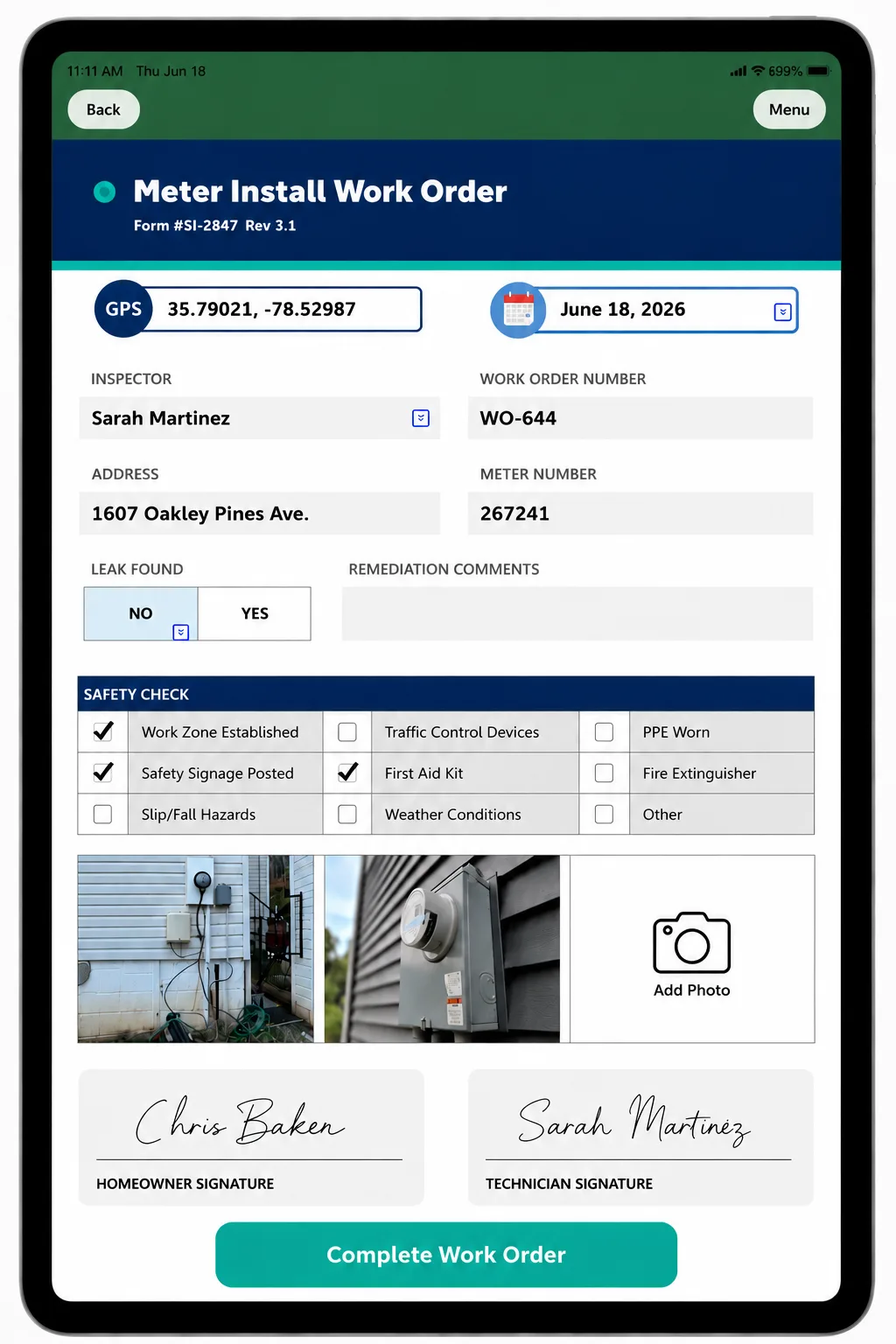
Safety inspections, incident reporting, permits, toolbox talks, and corrective actions all run on the same platform used for your broader field operations — giving safety, operations, and leadership one shared view of risk and compliance. Teams complete safety workflows on phones and tablets — fully offline — capturing sign-offs, geotagged photos, and timestamps. A flagged hazard automatically creates a corrective-action task, assigns an owner, notifies the right people, and tracks it through to a verified fix, with the results feeding management review and leadership dashboards.
Everything your safety and EHS teams need
Safety Inspections & Compliance
Toolbox talks, JHAs, near-miss reports, incident reports, and safety audits — built to match the forms your teams already use, with required fields and validation so nothing comes back incomplete.
Corrective-Action Workflows
A failed or hazardous item automatically generates a corrective-action task, assigns an owner, notifies the right people, and tracks the item to closure.
Incident & Near-Miss Reporting
Crews report incidents, hazards, and near-misses the minute they occur. Forms route instantly to safety managers and leadership with photos, GPS, and timestamps attached.
Compliance & Audit Management
Every safety record is timestamped, signed, and stored. Produce a complete, searchable history for a regulator or incident investigation in seconds.
Work Permits
Digitize confined space, hot work, lockout/tagout, energized work, excavation, and other permit-to-work processes with approvals, signatures, and audit trails.
Training & Competency Tracking
Document safety orientations, certifications, recurring training, acknowledgements, and employee sign-offs while maintaining a complete audit trail.
Safety Analytics & Dashboards
Leading and lagging indicators, TRIR, corrective-action performance, and audit readiness on live executive and frontline dashboards.
Enterprise Integrations
Connect to ERP, HR, CMMS, SQL databases, and Active Directory through APIs, eliminating duplicate data entry between safety and the rest of the business.
A full safety operations platform — not just another EHS app.
Field2Base doesn’t simply digitize safety documentation. Every inspection, incident, toolbox talk, permit, and corrective action becomes structured operational data that organizations use to continuously improve safety performance — not just document compliance. Unlike standalone EHS or safety inspection applications, Field2Base combines mobile inspections, workflow automation, corrective action management, offline capability, analytics, and enterprise integrations into one platform. Organizations typically start with inspections, incident reporting, and toolbox talks, then expand into permits, contractor management, environmental compliance, training, quality, maintenance, and other operational workflows — all on the same connected platform.
One platform, not a point solution
Safety runs alongside every other field workflow your teams already manage on Field2Base.
Enterprise integrations
Connect to ERP, HR, CMMS, SQL databases, and BI tools through APIs — eliminating duplicate data entry.
Offline-first mobile app
Full functionality on remote sites and in dead zones, with automatic sync on reconnect.
Operational dashboards
Executive and frontline views of safety performance, side by side with the rest of your operations.
From federal mandates to your own checklists — all on one platform.
Field2Base can digitize the exact federal, state, and agency-required forms your EHS program depends on — matched to the official layout — alongside every internal safety workflow your teams already run.
- ✓OSHA 300 / 300A / 301 logs
- ✓OSHA inspection forms
- ✓EPA & environmental reporting
- ✓DOT / FMCSA safety records
- ✓State & local agency forms
- ✓Job Safety Analysis (JSA / JHA)
- ✓Toolbox talks & sign-offs
- ✓Pre-task hazard assessments
- ✓Permit-to-work & hot-work permits
- ✓PPE & equipment checks
- ✓Site safety audits
- ✓Equipment & facility inspections
- ✓Behavior-based safety observations
- ✓Environmental monitoring
- ✓Custom checklists
Turn every finding into a closed-out fix.
The moment an inspector flags a failed item, hazard, or near-miss, Field2Base automatically creates a corrective action, assigns an owner, notifies the right people, and tracks the issue through verified closure—so nothing falls through the cracks before the next audit.
See your safety program in real time — not at quarter-end.
Every submitted form becomes structured data the moment it syncs. Track leading and lagging indicators, monitor corrective-action performance and audit readiness, and give executives a live view of program health — not a TRIR number buried in a spreadsheet.